
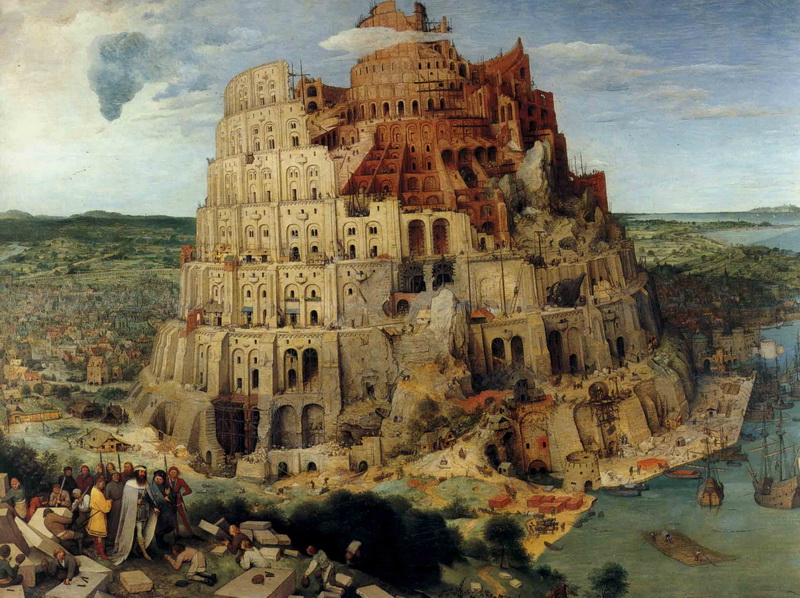
Pieter Bruegel the Elder, The Tower of Babel (c. 1563)
The Babelhouse story
The Tower of Babel and the painting by Pieter Bruegel the Elder
According to the Bible, the Tower of Babel was a tower meant to reach the heavens, built by the proud people of the great city of Babel. God was angered by their plan and confused the builders’ languages, so that one day they suddenly could no longer understand one another. They scattered and left the tower unfinished.
Our art, culture and language centre uses this allusion in its name, Babelhouse, kindly and with a sense of humour: as a symbol of today’s multicultural world, where the “confusion” of different cultures and languages can be understood by getting to know them better and learning to see them in harmony.
By a twist of fate, a small crooked staircase leads from our coffee table up to the classroom, and the wall of our 19th-century Old Town house curves towards Toome Hill. So we really are, in a way, inside the Tower of Babel!
A symbol of language and art
The painting that became our symbol, The Tower of Babel (c. 1563) by the Netherlandish master Pieter Bruegel the Elder, is at least as famous as his Netherlandish Proverbs (Nederlandse Spreekwoorden, 1559), in which every scene depicts a well-known proverb.
Symbolically, the painting links the use (and learning) of language with art, just as our studio alternates between art courses and activities (from life drawing at the highest level to relaxed, unhurried making where you can find yourself) and language courses, all in a creative and free atmosphere.
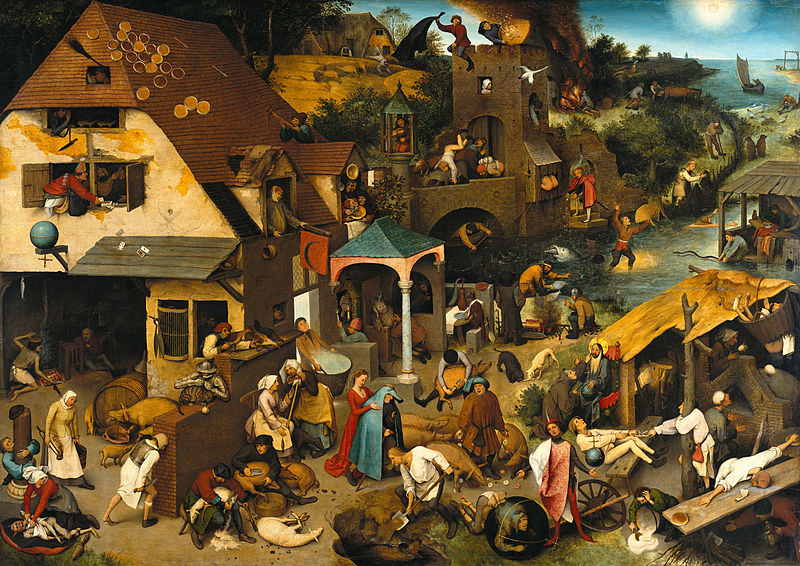
Pieter Bruegel the Elder, Netherlandish Proverbs (1559)
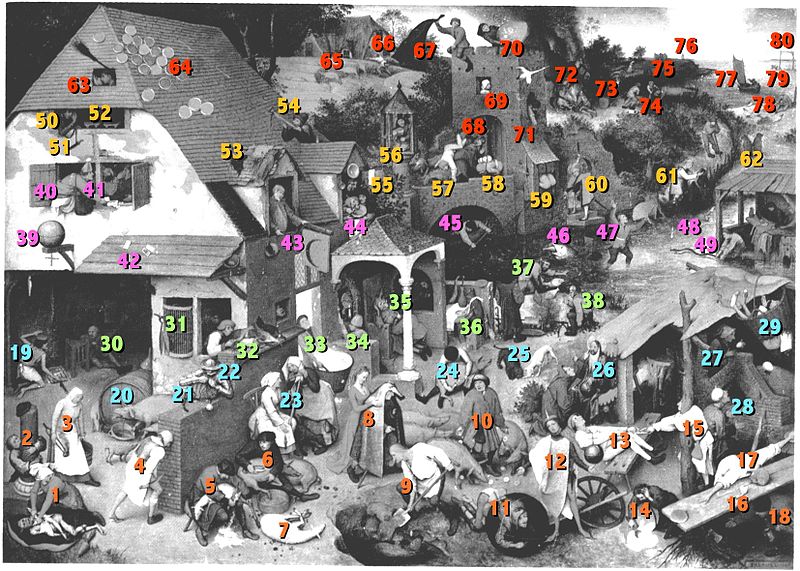
The same painting with each proverb numbered
Many towers, many meanings
References to the Tower of Babel can be found in many cultures and religions, and the tower has been linked to a number of famous buildings (read more here). Today it is often compared to the European Parliament building in Strasbourg.
As a strong symbol, the Tower of Babel appears widely in art and is interpreted in very different ways; Juri Lotman, for one, wrote about the role of symbols in a culture. The image in our logo stands for the principle “clarity into confusion!” and “understanding through tolerance and knowledge”. Knowing languages, cultures and art certainly helps along the way.
So why not start, or keep growing, on this path with us, in our lovely classroom, reached by a slightly clumsy crooked staircase, its outer wall curved, as the 19th-century architects of central Tartu wished, just like the Tower of Babel seen from inside!